


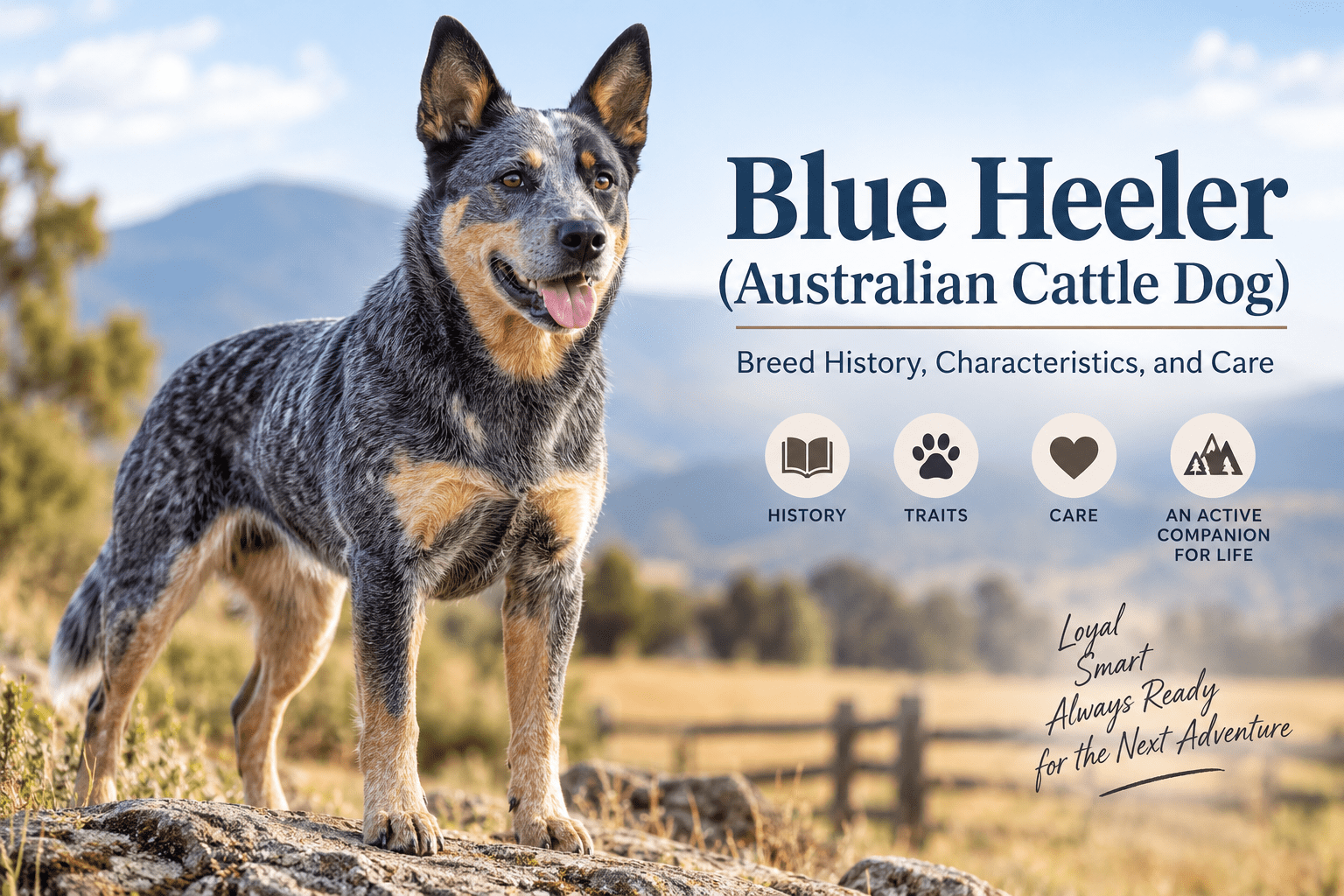
The Blue Heeler, officially known as the Australian Cattle Dog, is a hardworking breed with a fascinating history and a personality that is very different from that of a typical relaxed companion dog. Developed to move cattle across the demanding Australian landscape, this breed was shaped by generations of selective breeding for stamina, intelligence, courage, and independence.
Today, Australian Cattle Dogs are popular with active families, outdoor enthusiasts, farmers, and people who enjoy dog sports. They can form exceptionally strong bonds with their owners, but their energy and working instincts also mean they need more structure and activity than many other breeds.
The name Blue Heeler refers to the blue-colored Australian Cattle Dog, while red-coated dogs are often called Red Heelers. Both are the same breed. The breed is recognized for its compact, muscular build, weather-resistant double coat, alert expression, and remarkable ability to work for long periods.
Australian Cattle Dog History and Origin
The Australian Cattle Dog was developed in Australia during the 19th century when cattle owners needed a dog capable of working in conditions that were very different from those faced by traditional European herding dogs.
Imported herding dogs struggled with Australia’s hot climate, rough terrain, long distances, and difficult cattle. Australian cattle operations often covered enormous areas, so the ideal working dog needed to have endurance and enough independence to make decisions without constant direction from a handler.
Breeders gradually developed dogs with the strength, stamina, intelligence, and resilience required for this demanding work. Historical accounts describe the use of imported herding dogs and the Australian Dingo in the development of the breed. Other breeds have also been suggested as contributors during the breed’s development, although the exact genetic history is not completely documented.
One important figure in the breed’s history was Thomas Hall, who used crosses involving blue-merle Collies and Dingoes. The resulting dogs became valuable working animals for Australian cattlemen. Over time, careful selection for working ability helped establish the type that became the Australian Cattle Dog.
The breed’s traditional job also explains one of its most recognizable behaviors. Australian Cattle Dogs were developed to move cattle by working close to the animals and using controlled heel-nipping when necessary. This working instinct remains present in many dogs today, even when they have never worked on a farm.
Why Is the Australian Cattle Dog Called a Blue Heeler?
The term Blue Heeler comes from the breed’s traditional cattle-working behavior and its commonly seen blue coat pattern.
“Heeler” refers to the dog’s tendency to work near the heels of cattle to encourage them to move. “Blue” describes the blue-gray or blue-speckled appearance that many Australian Cattle Dogs develop.
Blue Heeler, Red Heeler, and Queensland Heeler are commonly used names for the Australian Cattle Dog. They do not describe separate breeds. Australian Cattle Dogs can have blue, blue-speckled, blue-mottled, or red-speckled coats according to breed standards.
Interestingly, Australian Cattle Dog puppies are generally born with predominantly white coats, with their adult coloring developing as they mature. The Dogs Australia breed information notes that the true color begins to appear at around three weeks of age.
Australian Cattle Dog Characteristics and Appearance
The Australian Cattle Dog is a medium-sized, muscular working dog designed for physical endurance rather than excessive size. The American Kennel Club describes the breed as compact and muscular, with typical adult height ranging from about 17 to 20 inches and weight generally around 35 to 50 pounds.
The body is strong and balanced, with powerful hindquarters, a deep chest, sturdy legs, and a muscular neck. These physical characteristics reflect the breed’s original purpose. A cattle dog needed to move quickly, change direction, cover considerable distances, and remain capable of working in difficult conditions.
The breed has erect ears, an alert expression, and a moderately broad head. Its tail is naturally present and is an important part of the breed’s structure. Despite the common association between the word “Heeler” and working cattle, the Australian Cattle Dog is not supposed to have a naturally short tail.
Its short double coat provides protection against changing weather conditions. The coat is practical rather than high maintenance, which was important for a dog expected to spend much of its life outdoors.
Australian Cattle Dog Temperament
The temperament of an Australian Cattle Dog is closely connected to its working history. These dogs are intelligent, alert, loyal, energetic, and naturally observant.
They often develop a particularly strong relationship with their household. Many Australian Cattle Dogs prefer staying close to their owners and being involved in daily activities rather than spending long periods alone. Their loyalty can be one of their most appealing qualities, but it also means they need regular interaction and meaningful activity.
Australian Cattle Dogs can be cautious around unfamiliar people. The breed standard describes them as naturally suspicious of strangers while remaining trustworthy and responsive to their owners. Early socialization can help a young dog become more comfortable around different people, animals, environments, and situations.
Their intelligence can also make them challenging for inexperienced owners. A dog that quickly understands commands can also quickly learn behaviors that an owner did not intend to encourage. Consistent rules, positive training, and appropriate outlets for energy are important.
Are Blue Heelers Good Family Dogs?
A Blue Heeler can be a devoted family companion, but the breed is not automatically the right match for every household.
The main consideration is activity level. Australian Cattle Dogs generally need owners who can provide regular physical exercise as well as mental challenges. They can fit well into an active household where hiking, running, training, outdoor activities, or dog sports are part of normal life.
Families with children should also understand the breed’s herding instincts. Some Australian Cattle Dogs may attempt to control movement by chasing, circling, or nipping at heels. This behavior is not necessarily an indication that the dog is being intentionally aggressive; it can be an expression of a deeply ingrained working instinct.
Young children should always be supervised around dogs, regardless of breed. Training should focus on teaching the dog appropriate behavior and teaching children how to interact respectfully with an animal.
How Much Exercise Does a Blue Heeler Need?
An Australian Cattle Dog needs considerably more activity than a dog that was bred primarily for companionship.
Daily walks are useful, but simply walking around the neighborhood may not provide enough stimulation for many individuals. A combination of physical activity, training, play, exploration, and problem-solving exercises is often more appropriate.
Activities such as hiking, running, obedience training, agility, herding activities, scent work, and retrieving games can provide useful outlets. The goal is not simply to tire the dog physically. Mental engagement is equally important because this breed was developed to think and make decisions while working.
An under-stimulated Australian Cattle Dog may look for its own entertainment. Chewing, digging, excessive barking, chasing, or other unwanted behaviors can develop when the dog does not receive enough appropriate activity. The American Kennel Club specifically recommends ongoing training and mentally stimulating activities for the breed.
Training an Australian Cattle Dog
Training should begin early and continue throughout the dog’s life. Australian Cattle Dogs are intelligent and capable of learning a wide range of behaviors, but intelligence does not eliminate the need for consistency.
Basic commands such as sit, stay, come, leave it, and walking calmly on a leash provide a useful foundation. Training should then progress into real-world situations where the dog learns to respond despite distractions.
Positive reinforcement can make training more productive because it gives the dog a clear reason to repeat desirable behavior. Short, regular sessions can also work better than long sessions that become repetitive.
Socialization deserves equal attention. A young Blue Heeler should gradually experience different people, safe dogs, household sounds, surfaces, environments, and everyday situations. The objective is to help the dog develop confidence while learning appropriate responses.
Because Australian Cattle Dogs have strong herding instincts, owners should pay particular attention to chasing and heel-nipping behavior. These habits should be redirected rather than encouraged as cute puppy behavior that will automatically disappear.
Grooming and Coat Care
One advantage of the Australian Cattle Dog is that its coat is relatively easy to maintain.
The short double coat generally needs regular brushing to remove loose hair and keep the coat in good condition. Weekly brushing is commonly sufficient during much of the year, while more frequent brushing can be helpful during heavier seasonal shedding periods.
Bathing is usually needed only when the dog becomes dirty or develops an odor. Over-bathing can remove natural oils from the skin, so a bathing schedule should be based on the individual dog rather than a fixed routine.
Nail trimming, ear checks, dental care, and regular inspection of the paws should also be part of routine grooming. Dogs that spend considerable time outdoors can pick up small injuries or foreign objects in their paws, making regular checks particularly useful.
Feeding a Blue Heeler
A balanced diet appropriate for the dog’s age, size, activity level, and health needs is important. A highly active working Australian Cattle Dog may have different nutritional requirements from a less active pet.
Portion sizes should be adjusted according to body condition rather than relying only on the feeding instructions printed on a food package. Puppies also need food formulated for growth, while adult dogs generally require an adult maintenance diet.
Treats should remain a modest part of the overall diet. Using small treats during training can be useful, but excessive treats can contribute to unwanted weight gain.
Fresh water should always be available, especially after exercise or during hot weather.
Australian Cattle Dog Health
Australian Cattle Dogs are generally considered a hardy breed, but responsible ownership still includes awareness of inherited health conditions.
Dogs Australia notes that hereditary conditions affecting the breed include progressive retinal atrophy (PRA) and primary lens luxation (PLL), and DNA testing is available for certain inherited conditions. Deafness can also occur, and a BAER hearing test can be used to evaluate hearing.
The Orthopedic Foundation for Animals and American College of Veterinary Ophthalmologists also identify several eye conditions relevant to the Australian Cattle Dog, including lens luxation and forms of progressive retinal atrophy. Genetic testing is available for certain mutations, although a test for one mutation does not rule out every possible eye disorder.
This is one reason responsible breeding matters. Prospective owners should ask breeders about relevant health testing and request documentation rather than relying only on verbal assurances. The OFA’s Canine Health Information Center explains that breed-specific health screening results can provide useful information for breeders and puppy buyers, although completion of required testing does not guarantee that an individual dog will never develop a health condition.
Routine veterinary examinations remain important throughout the dog’s life. Your veterinarian can recommend an appropriate vaccination schedule, parasite prevention, dental care, weight management, and screening based on the individual dog.
Is a Blue Heeler Right for You?
Before bringing home an Australian Cattle Dog, consider what the breed was originally designed to do.
This is an active working breed with a strong desire to participate in its owner’s life. It may be an excellent match for someone who enjoys outdoor activities, structured training, dog sports, or other forms of daily engagement.
It may be a more difficult choice for someone looking for a dog that is content with occasional walks and long periods of inactivity. The breed’s intelligence and energy can become challenging when its needs are consistently overlooked.
Housing size is not the only consideration. A Blue Heeler can live in different types of homes when its physical and mental needs are properly met. What matters most is whether the owner can provide enough exercise, training, companionship, supervision, and structure.
Tips for Caring for a Blue Heeler
Good Australian Cattle Dog care is based on consistency rather than complicated routines. Give the dog regular opportunities to exercise, provide activities that require thinking, maintain basic grooming, and keep up with veterinary care.
Training should be part of everyday life rather than something reserved for puppyhood. Asking for a calm sit before meals, practicing recall during safe outings, or working on leash manners can turn ordinary routines into useful training opportunities.
It is also important to give the dog appropriate rest. A highly active breed still needs adequate sleep and quiet time. Puppies in particular should not be pushed into excessive exercise simply because they appear energetic.
Most importantly, understand the instincts behind the behavior. A Blue Heeler that wants to follow, watch, chase, control movement, or stay close to its owner is often displaying traits that were intentionally developed over generations. Good ownership involves directing those instincts into safe and useful activities.
Final Thoughts on the Australian Cattle Dog
The Blue Heeler, or Australian Cattle Dog, is a remarkable example of a breed shaped by practical need. Its history as an Australian cattle-working dog explains its endurance, intelligence, alertness, loyalty, and strong desire to have a purpose.
For the right household, these qualities can make the Australian Cattle Dog an engaging and deeply loyal companion. However, the same traits can become difficult when the dog’s need for exercise, training, socialization, and mental stimulation is underestimated.
Understanding the breed before bringing one home is therefore one of the most important parts of responsible ownership. With appropriate training, regular activity, good nutrition, routine veterinary care, and plenty of positive interaction, an Australian Cattle Dog can become a valued member of an active household.
Frequently Asked Questions About Blue Heelers
Is a Blue Heeler the same as an Australian Cattle Dog?
Yes. Blue Heeler is a common name for the Australian Cattle Dog, particularly for dogs with blue or blue-speckled coats. Red Heeler and Queensland Heeler are also names commonly associated with the same breed.
How long do Australian Cattle Dogs live?
Australian Cattle Dogs are generally considered a long-lived breed. Dogs Australia states that they commonly live to 15 years or more, although lifespan varies between individual dogs and depends on genetics, nutrition, veterinary care, lifestyle, and other factors.
Are Blue Heelers aggressive?
A Blue Heeler is not automatically an aggressive dog. The breed can be reserved around strangers and may be protective of its family, while its herding instincts can cause chasing or heel-nipping behavior. Early socialization, appropriate training, responsible management, and understanding individual temperament are important.
Are Blue Heelers good with children?
They can be good family companions, particularly in active households, but supervision is important. Their natural herding behavior can include chasing or nipping at moving children, so young dogs should be taught appropriate behavior from an early age.
How much exercise does an Australian Cattle Dog need?
Australian Cattle Dogs need regular physical exercise combined with mental stimulation. Walks, hiking, running, training, agility, retrieving games, scent activities, and other structured activities can help meet their needs. The exact amount should be adjusted according to the dog’s age, health, fitness, and individual energy level.
Do Blue Heelers shed a lot?
They have a short double coat and do shed. Regular brushing can remove loose hair, while more frequent brushing is useful during heavier seasonal shedding periods. Their coat is generally considered relatively easy to maintain.
Are Australian Cattle Dogs easy to train?
They are highly intelligent and capable of learning quickly, but that does not necessarily make them easy for every owner. Their independence, energy, and strong working instincts require consistent training and clear boundaries. Early socialization and lifelong training are recommended.
Do Blue Heelers need a lot of grooming?
No. Their short, weather-resistant coat does not require complicated grooming. Regular brushing, occasional bathing, nail care, dental care, and routine checks of the ears, eyes, and paws are generally more important than elaborate coat maintenance.
What health problems can Australian Cattle Dogs have?
The breed can be affected by inherited conditions, including certain forms of progressive retinal atrophy and primary lens luxation. Deafness can also occur. Responsible breeders can use available health examinations and genetic tests to reduce the risk of passing certain inherited conditions to puppies.
Is a Blue Heeler a good dog for a first-time owner?
It depends heavily on the owner’s lifestyle, time, and willingness to train. The breed’s intelligence and energy can be rewarding, but its strong working instincts require consistent exercise, socialization, supervision, and mental engagement. A prospective owner should understand these needs before choosing the breed.