


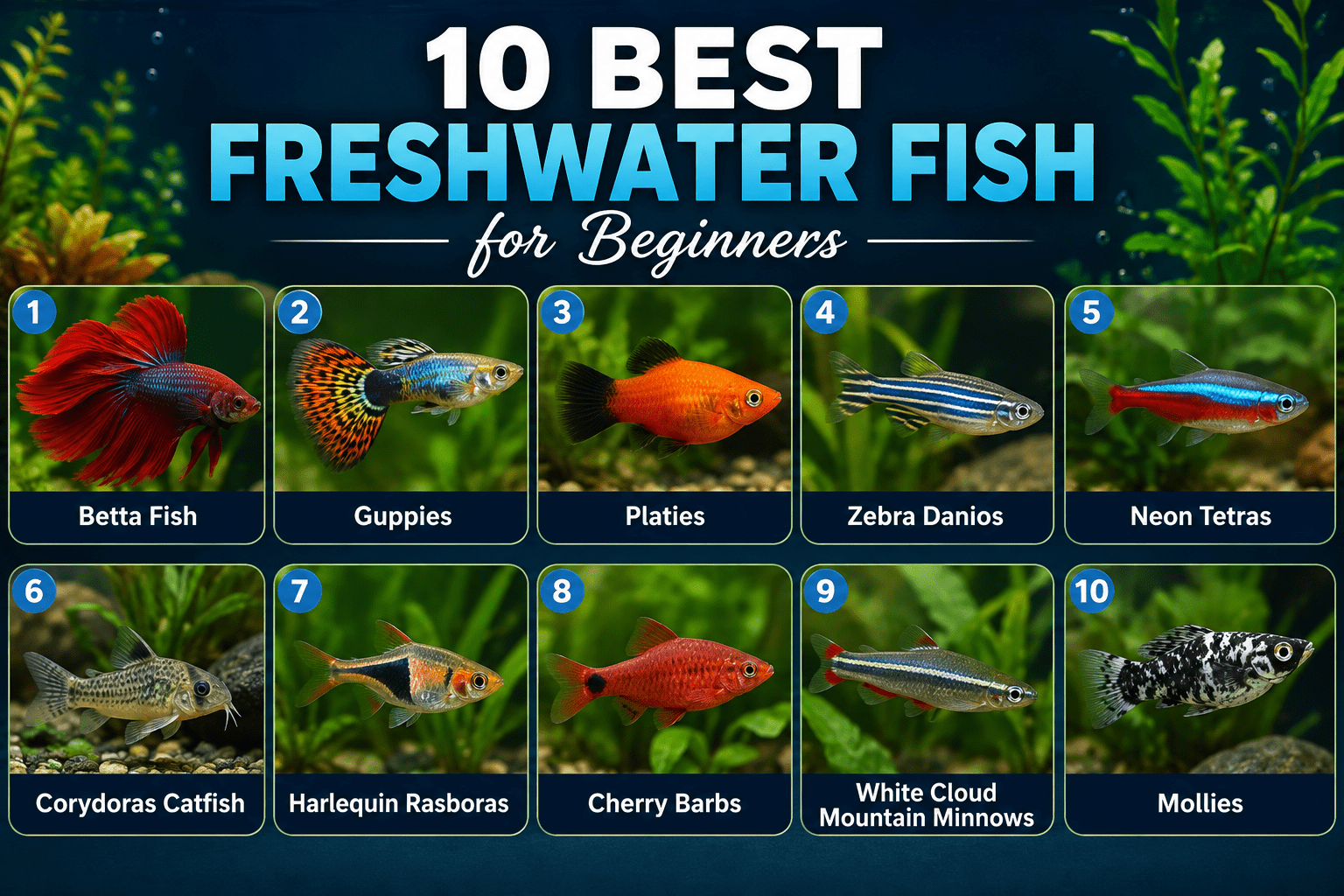
Starting a freshwater aquarium can be a surprisingly rewarding way to bring more life into your home. Watching fish explore plants, interact with one another, and settle into their surroundings can be relaxing, but choosing the right species is an important part of creating a healthy aquarium. A fish that looks beautiful in a store may not necessarily be a good choice for a first-time fish keeper.
The best freshwater fish for beginners are generally hardy, reasonably easy to care for, and suitable for the type of aquarium you plan to maintain. However, beginner-friendly does not mean maintenance-free. Every fish still needs clean water, suitable temperature, appropriate food, enough swimming space, and compatible tankmates.
This guide covers ten freshwater fish that can work well for beginners, along with their basic care needs and the important considerations to make before buying them.
What Makes a Freshwater Fish Good for Beginners?
A good beginner fish should match your aquarium rather than simply being described as “easy” or “hardy.” A hardy species may tolerate minor changes better than a sensitive species, but poor water quality, overcrowding, unsuitable temperatures, or an uncycled aquarium can still cause serious problems.
Peaceful behavior is another useful quality for a first aquarium. Community fish can make a good choice when you want several species living together, provided their temperature, water conditions, adult size, and temperament are compatible. Schooling fish also need enough companions to feel secure, while some species are better kept alone.
Before buying any fish, consider the adult size of the species, the minimum appropriate tank size, how many fish it should live with, and the amount of maintenance you can realistically provide. A slightly larger aquarium is often easier to keep stable than a very small one because changes in water quality can happen more quickly in small volumes.
1. Betta Fish
Betta fish (Betta splendens) are among the most recognizable freshwater aquarium fish, and their colorful bodies and flowing fins make them especially appealing to beginners. They can also be kept as a single fish, which makes them easier to plan for than species that require a large school.
A betta needs more than a decorative bowl. A properly equipped aquarium should provide clean, stable water, gentle filtration, a suitable temperature, hiding places, and access to the water surface. Bettas can breathe atmospheric air because they have a labyrinth organ, but this does not mean they should live in poor-quality water or cramped containers.
Male bettas are territorial and should not be housed with another male. Some bettas can live in carefully selected community aquariums, but a single-betta setup is often the simpler choice for someone new to fishkeeping.
Best for: Beginners who want a single colorful fish with a distinctive personality.
2. Guppies
Guppies (Poecilia reticulata) are colorful, active, and widely available, making them one of the classic choices for a beginner freshwater aquarium. Their small size and peaceful nature make them suitable for many community setups when the aquarium is properly stocked.
One important point is that guppies reproduce readily. If males and females are kept together, a small group can quickly become a much larger population. Beginners who do not want to manage fry may prefer an appropriately planned single-sex group.
Guppies are also active swimmers, so providing adequate horizontal swimming space is important. Their diet can include quality commercial foods, with variety added when appropriate. Like all fish, they benefit from stable water conditions rather than being treated as animals that can simply tolerate neglect.
Best for: Beginners who want colorful, lively community fish and do not mind managing a group.
3. Platies
Platies are another excellent option for people looking for peaceful freshwater aquarium fish. They are generally active without being excessively aggressive, and their different colors and patterns can add variety to a community aquarium.
Like guppies, platies are livebearers. Females give birth to free-swimming young rather than laying eggs, so keeping males and females together can result in frequent breeding. This is something to consider before purchasing a mixed group.
Platies also benefit from a well-maintained aquarium with plants or other areas where they can explore and find cover. They are omnivorous and can be fed a suitable commercial diet alongside occasional appropriate additions.
Best for: Beginners who want hardy, peaceful fish with plenty of color and movement.
4. Zebra Danios
Zebra danios (Danio rerio) are small, energetic fish known for their striped bodies and constant activity. They are considered hardy and can tolerate a relatively broad range of aquarium conditions, which is one reason they are frequently recommended for new fish keepers.
However, their active nature is important when choosing a tank. Zebra danios need room to swim, and a longer aquarium is generally more suitable than a tall, narrow one. They are schooling fish and should be kept in a proper group rather than as a single fish.
Their fast movements can make them a lively addition to a community aquarium, but they may not be the best match for very slow-moving species. Providing swimming space and compatible tankmates will help reduce stress and unnecessary competition.
Best for: Beginners who enjoy active schooling fish and have enough swimming space.
5. Neon Tetras
Neon tetras (Paracheirodon innesi) are small schooling fish recognized for their bright blue and red coloration. A group moving together through a planted aquarium can create an attractive display without requiring large fish.
Their small size can make them seem like an obvious choice for any small tank, but beginners should avoid using their size alone to determine stocking. Neon tetras need a suitable group and stable water conditions. They are not a substitute for proper aquarium cycling or regular maintenance.
A planted community aquarium with gentle tankmates can provide a comfortable environment for neon tetras. Their peaceful temperament also makes them a popular choice for community setups when other fish have similar needs.
Best for: Beginners who want a peaceful school of small, colorful fish.
6. Corydoras Catfish
Corydoras catfish are small bottom-dwelling fish that bring a completely different type of activity to a freshwater aquarium. Rather than spending most of their time in the upper or middle levels, they spend much of their time exploring the substrate.
Corydoras are social fish and generally do better when kept with others of their kind. A suitable group should be planned according to the species and aquarium size. They should also receive food intended for bottom-dwelling fish rather than being expected to survive entirely on leftovers.
Smooth substrate is a sensible choice because these fish spend considerable time searching along the bottom. A well-designed aquarium with hiding places and open areas gives them opportunities to behave naturally.
Best for: Beginners who want peaceful bottom-dwelling fish for a community aquarium.
7. Harlequin Rasboras
Harlequin rasboras (Trigonostigma heteromorpha) are peaceful schooling fish with a distinctive copper-colored body and dark marking near the rear of the body. They are a popular choice for planted community aquariums because they remain relatively small and generally have a calm temperament.
As schooling fish, harlequin rasboras should not be kept alone. A properly sized group allows them to behave more naturally and can make them more confident in the aquarium.
They are also best kept with similarly peaceful fish rather than aggressive species that may chase or intimidate them. A stable aquarium, suitable filtration, and regular maintenance are more important than trying to make the tank complicated.
Best for: Beginners who want a calm schooling fish with attractive coloration.
8. Cherry Barbs
Cherry barbs (Puntius titteya) are peaceful freshwater fish that can add warm red coloration and plenty of activity to a community aquarium. They are generally less intimidating than many larger barb species and can work well in a carefully planned beginner setup.
Keeping them in a suitable group is important because social interaction is part of their normal behavior. They can be combined with other peaceful species when their environmental needs overlap.
A planted aquarium can be particularly attractive for cherry barbs because vegetation provides cover while still leaving open swimming areas. Their omnivorous diet can be supported with quality commercial food and appropriate variety.
Best for: Beginners who want colorful schooling fish with a peaceful reputation.
9. White Cloud Mountain Minnows
White cloud mountain minnows (Tanichthys albonubes) are an interesting choice because they are often associated with cooler freshwater aquariums rather than the warmer conditions preferred by many tropical fish.
They are small, active schooling fish that can be attractive in a simple aquarium. Their temperature requirements make them worth considering if you do not want to maintain a tropical setup, although the temperature of the aquarium should always be matched to the particular species you keep.
Do not assume that a fish described as a “cold-water fish” can tolerate any temperature. Sudden changes can still cause stress, and the aquarium should be kept within a suitable range for the species.
Best for: Beginners interested in a cooler freshwater aquarium and peaceful schooling fish.
10. Mollies
Mollies are another popular livebearing freshwater fish that can suit beginners when their space and water requirements are properly considered. They come in several forms and colors, which gives new fish keepers plenty of choices when designing a community aquarium.
Mollies are active and can grow larger than some of the other fish on this list, so they should not be selected simply because they are commonly sold as beginner fish. The adult size of the particular variety and the number of fish you plan to keep should influence your tank choice.
As with other livebearers, breeding is an important consideration. A mixed-sex group can produce young regularly, so plan your stocking before bringing mollies home.
Best for: Beginners with enough aquarium space for active livebearers.
How to Choose the Best Beginner Fish for Your Aquarium
The best fish for you depends on the aquarium you already have or plan to set up. Do not buy fish first and then try to build a tank around them. It is much easier to choose the aquarium, equipment, and stocking plan first.
For a single betta, a properly equipped aquarium can be a straightforward starting point. For schooling fish such as neon tetras, harlequin rasboras, zebra danios, and white cloud mountain minnows, you need to account for the number of fish required to form a healthy group.
You should also consider where the fish normally spend their time. Combining species that use different areas of the aquarium can create a more interesting community, but only when their care requirements and temperaments match.
Most importantly, never use a general “one inch of fish per gallon” rule as your only stocking guide. Fish differ in body shape, activity level, waste production, social needs, and swimming requirements. Stocking should be based on the actual species and aquarium setup.
Cycle Your Freshwater Aquarium Before Adding Fish
One of the most important steps for beginners is cycling the aquarium before introducing fish. A new aquarium does not automatically have enough beneficial bacteria to process the waste produced by fish.
During the nitrogen cycle, beneficial bacteria help convert toxic ammonia into nitrite and then into nitrate. An immature aquarium can therefore develop dangerous ammonia or nitrite levels if fish are added too soon.
A properly cycled aquarium should have stable conditions and no detectable ammonia or nitrite before fish are introduced. The exact cycling time can vary, so testing the water is more useful than relying only on a certain number of days.
This is also why a clear aquarium is not necessarily a safe aquarium. Water can look perfectly clean while harmful compounds are present. Testing gives you information that your eyes cannot provide.
Feed Beginner Fish Carefully
Overfeeding is one of the easiest mistakes to make when starting an aquarium. Fish may continue eating even when they do not need additional food, while uneaten food eventually breaks down and adds waste to the aquarium.
Offer an amount your fish can consume promptly rather than scattering large quantities into the tank. The correct diet also depends on the species. A betta, bottom-dwelling Corydoras, schooling tetra, and livebearer may not all have exactly the same dietary needs.
It is better to provide appropriate food in sensible portions than to use feeding as a way of keeping fish active throughout the day.
Maintain Water Quality Regularly
Regular maintenance is more important than choosing a fish that is supposedly “easy.” Test your water when needed, remove waste, perform appropriate water changes, and keep your filter functioning properly.
Tap water should also be treated appropriately before it is added to an aquarium. Chlorine and chloramine used in municipal water supplies can be harmful to aquatic animals, so a suitable water conditioner is an important part of routine fish care.
Avoid replacing all filter media at once unless there is a specific reason to do so. Beneficial bacteria live on aquarium surfaces, including filter media, and preserving that biological environment helps keep the aquarium stable.
Avoid Overstocking Your First Aquarium
A common beginner mistake is adding several species because each fish looks appealing individually. The problem is that the aquarium has to support the combined needs of every fish, not just the size of each fish at the time of purchase.
Start conservatively. Give the aquarium time to adjust to its biological load before considering additional fish, and monitor water quality after stocking changes.
Compatibility also matters. A peaceful fish can become stressed when housed with aggressive or excessively active tankmates. Research each species before putting it into a community aquarium.
Which Freshwater Fish Are Easiest for Beginners?
There is no single fish that is perfect for every beginner. A betta may be the simplest choice for someone who wants one fish, while guppies or platies may appeal to someone who wants a colorful community. Zebra danios suit people who enjoy active swimmers, while Corydoras are interesting for those who want activity near the bottom of the aquarium.
The easiest fish is ultimately the one whose needs you can consistently meet. Choosing a species that matches your tank size, water conditions, available time, and experience is much more important than choosing a fish because someone called it “hardy.”
Final Thoughts
Starting a freshwater aquarium does not have to be complicated, but it does require planning. The most beautiful aquarium is not necessarily the one with the greatest number of fish. A healthy aquarium gives its inhabitants enough space, stable water conditions, suitable food, compatible companions, and an environment where they can behave naturally.
The ten species covered here offer several different ways to begin. Bettas can suit a simple single-fish setup, while guppies, platies, tetras, rasboras, danios, barbs, minnows, mollies, and Corydoras can bring movement and variety to community aquariums when they are stocked correctly.
Take time to cycle the tank, research each species before buying it, and resist the temptation to add too many fish at once. With thoughtful planning and consistent care, your first freshwater aquarium can become a rewarding part of your home and a healthy environment for the fish you choose.
Frequently Asked Questions
What is the best freshwater fish for a beginner?
Betta fish, guppies, platies, zebra danios, neon tetras, Corydoras, harlequin rasboras, cherry barbs, white cloud mountain minnows, and mollies can all be suitable for beginners when their individual care requirements are met. The best choice depends on aquarium size, temperature, group requirements, and compatibility.
What is the easiest fish to take care of?
Betta fish are often considered one of the easier choices because a single fish can be kept without managing a large school. However, they still need a properly maintained, heated, filtered, and cycled aquarium.
What fish can live together in a beginner aquarium?
Peaceful species with similar water and temperature requirements can often share a community aquarium. Guppies, platies, some tetras, rasboras, and Corydoras may work together in an appropriately sized setup, but compatibility should always be checked before combining species.
How many fish should a beginner start with?
There is no universal number because stocking depends on the species and aquarium size. Schooling fish need an appropriate group, while a betta can be kept alone. It is generally safer to stock conservatively rather than adding many fish at once.
Can I put fish in a new tank immediately?
It is not recommended to add fish immediately to a newly established aquarium. The tank should first develop the biological filtration needed to process fish waste, and water should be tested to confirm that ammonia and nitrite are at safe levels.
Are betta fish good for beginners?
Yes, betta fish can be good beginner fish when their basic needs are properly met. They require stable, clean water, suitable warmth, gentle water movement, appropriate food, and a secure aquarium rather than a tiny decorative container.
Do freshwater fish need a filter?
Most freshwater aquariums benefit greatly from filtration. A filter helps remove waste and provides an important surface for beneficial bacteria involved in the nitrogen cycle. The correct filter should provide appropriate flow for the species being kept.
How often should I change aquarium water?
Water-change schedules depend on aquarium size, stocking, filtration, plants, and test results. Instead of following one fixed schedule for every tank, monitor water quality and establish a consistent maintenance routine appropriate for your aquarium.
What should I feed beginner freshwater fish?
Choose a quality food designed for the species you keep. Many community fish can eat suitable flakes or small pellets, while bottom-dwelling species may need sinking foods. Feeding small portions helps reduce uneaten food and unnecessary waste.
What is the biggest mistake new fish owners make?
Adding fish before the aquarium is biologically ready is one of the most serious beginner mistakes. Overstocking, overfeeding, unsuitable tankmates, and neglecting water testing are also common problems.