


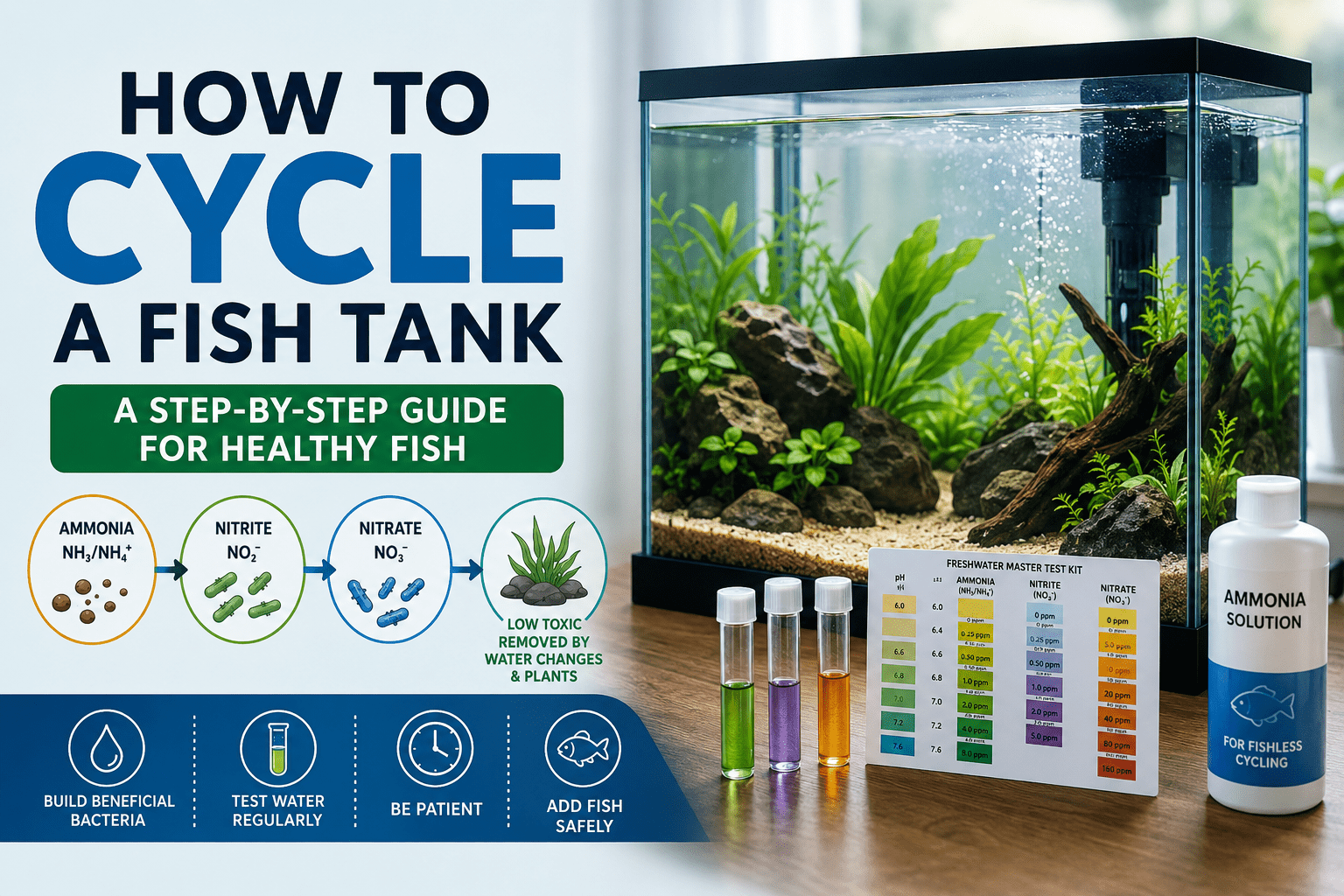
Setting up a new aquarium can be exciting. You choose the tank, arrange the substrate and decorations, fill it with water, and naturally start thinking about which fish you want to add. However, one of the most important steps happens before the first fish enters the aquarium: cycling the fish tank.
A new aquarium may look clean and ready, but clean water does not necessarily mean safe water. A newly established tank does not yet have enough beneficial bacteria to process the waste produced by fish. Without those bacteria, toxic ammonia and nitrite can build up quickly.
This guide explains the aquarium nitrogen cycle in simple terms, shows you how to cycle a new fish tank step by step, explains how to know when the cycle is complete, and covers common mistakes that can delay the process.
What Does Cycling a Fish Tank Mean?
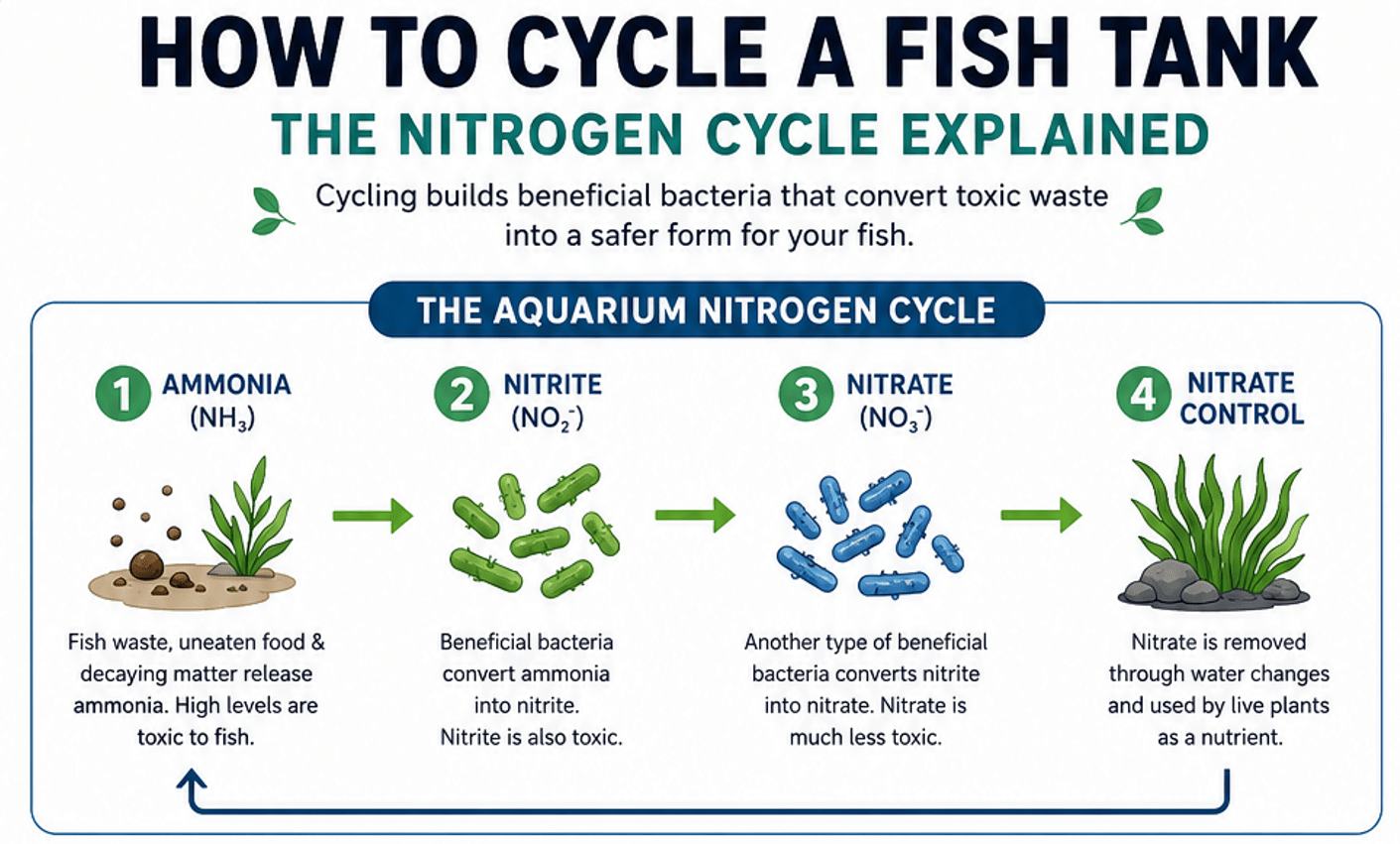
Cycling a fish tank means establishing a colony of beneficial bacteria that can process toxic waste produced inside the aquarium.
Fish waste, leftover food and decaying organic material can release ammonia into the water. Ammonia is toxic to fish. As the aquarium develops, one group of bacteria converts ammonia into nitrite, which is also harmful. Another group then converts nitrite into nitrate, which is considerably less toxic and can be managed through water changes and plant growth.
The basic process looks like this:
Ammonia → Nitrite → Nitrate
This process is known as the aquarium nitrogen cycle.
The purpose of cycling is not simply to let water sit for several days. It is to establish enough biological activity to handle the amount of waste your future fish will produce.
Why Is Cycling a New Fish Tank Important?
The biggest mistake a new fish keeper can make is assuming that a freshly filled aquarium is automatically ready for fish.
A brand-new tank may have a filter, heater, gravel and decorations, but its biological filtration is not fully established. When fish are added, their waste can cause ammonia levels to rise before enough beneficial bacteria are available to process it.
This can lead to what is commonly called new tank syndrome. Fish may become stressed, stop eating, breathe rapidly, remain near the surface, or develop other signs of poor health when water quality deteriorates.
Cycling the aquarium first creates a biological foundation for the fish. It is much easier to establish that foundation while the tank is empty than to deal with dangerous ammonia and nitrite levels after fish have already been introduced.
Understanding the Aquarium Nitrogen Cycle
You do not need a chemistry background to understand the nitrogen cycle.
Stage 1: Ammonia Builds Up
Ammonia enters an aquarium through fish waste, uneaten food and decomposing organic material. In a new aquarium, there may initially be very little beneficial bacteria available to process it.
During a fishless cycle, you deliberately provide an ammonia source so that the bacteria have something to consume.
Stage 2: Ammonia Becomes Nitrite
As the first group of nitrifying bacteria becomes established, ammonia is converted into nitrite.
This is an important sign that the cycle is progressing, but it does not mean the aquarium is ready for fish. Nitrite is also toxic and needs to be processed further.
Stage 3: Nitrite Becomes Nitrate
A second group of bacteria converts nitrite into nitrate.
Nitrate is much easier to manage than ammonia or nitrite. Regular partial water changes help remove it, while aquatic plants can also use nitrate as a nutrient.
A properly established aquarium therefore has a biological system that continuously processes fish waste instead of allowing toxic compounds to accumulate.
What You Need to Cycle a Fish Tank
You do not need a complicated collection of equipment to begin cycling an aquarium. The exact equipment will depend on your tank, fish species and setup, but beginners should have:
- A properly sized aquarium filter
- A water conditioner that removes chlorine and chloramine from tap water
- An aquarium heater when keeping species that require heated water
- A reliable test kit for ammonia, nitrite and nitrate
- An ammonia source for a fishless cycle
- A thermometer
- A source of beneficial bacteria if you choose to use one
The filter is particularly important because biological filtration depends heavily on surfaces where beneficial bacteria can establish themselves. Filter sponges, ceramic media and other biological filter materials provide useful surfaces for these bacterial colonies.
How to Cycle a Fish Tank Using the Fishless Method
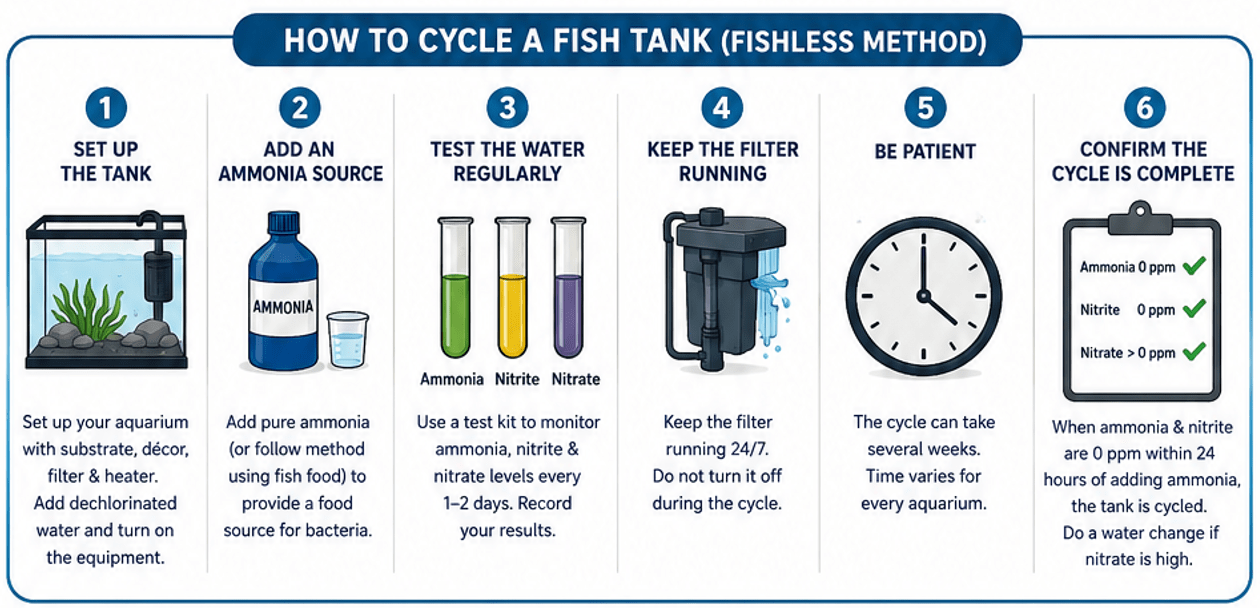
A fishless cycle is the preferred method for most beginners because no fish have to endure the ammonia and nitrite spikes that occur while the bacterial colonies are developing. Current aquarium guides generally recommend establishing the cycle before introducing livestock.
1. Set Up the Aquarium Completely
Start by setting up the aquarium as you intend to use it.
Add the substrate, decorations and plants, then fill the aquarium with water treated with an appropriate water conditioner. Install the filter and heater if your fish require one.
Turn the filter on and keep it running continuously.
If you are keeping tropical freshwater fish, set the temperature according to the needs of the species you plan to keep rather than choosing a temperature simply because it is commonly recommended for cycling.
At this stage, there should be no fish in the aquarium.
2. Add an Ammonia Source
Beneficial bacteria need a food source. During a fishless cycle, that source is ammonia.
Many aquarists use an aquarium-specific ammonia product because it allows the amount added to be measured more precisely. Another commonly discussed approach is using fish food as an ammonia source, although this can be slower and more difficult to control because the food has to break down before it produces ammonia.
If you use bottled ammonia, follow the manufacturer’s directions carefully. Do not add household cleaning ammonia unless you are certain that it contains no perfumes, detergents or other additives that could be harmful to an aquarium.
3. Test the Water Regularly
Testing is what tells you whether the nitrogen cycle is actually developing.
Use an aquarium test kit to monitor:
- Ammonia
- Nitrite
- Nitrate
At first, ammonia should rise because there are not yet enough bacteria to process it. As the first bacterial population grows, ammonia begins to decline and nitrite appears.
Later, nitrite should begin falling as the second bacterial population becomes established and converts it into nitrate.
Keeping a simple record of your readings can make this progression much easier to understand.
4. Keep the Filter Running
The filter should remain operational throughout the cycling process.
Turning the filter off for long periods can interfere with the biological environment developing inside the filter media. The beneficial bacteria you are trying to establish need suitable conditions and a continuous flow of oxygen-rich water.
Do not replace biological filter media simply because it looks dirty during the cycling process. If cleaning is necessary, follow the filter manufacturer’s instructions and avoid washing biological media with untreated tap water containing chlorine or chloramine.
5. Be Patient While the Bacteria Establish
One of the hardest parts of learning how to cycle a fish tank is accepting that the process takes time.
There is no reliable universal number of days that guarantees an aquarium is cycled. Many new tanks take several weeks, and the exact timeline can vary depending on the setup, temperature, pH, ammonia source and development of the bacterial colonies.
Do not add fish simply because the tank has been running for seven, ten or fourteen days.
Your test results matter more than the calendar.
How Do You Know When a Fish Tank Is Cycled?
This is one of the most important questions beginners ask.
A tank should not be considered cycled simply because the water looks clear or because nitrate has appeared.
The stronger test is whether the established biological filtration can process an appropriate ammonia dose within a short period. A commonly used fishless-cycle endpoint is being able to add an ammonia source and then measure zero ammonia and zero nitrite within about 24 hours, with nitrate present as evidence that the process is occurring.
The exact testing procedure can vary depending on the ammonia product and cycling method, so follow the instructions for the method you are using.
Before adding fish, perform an appropriate partial water change if nitrate has accumulated significantly. Then confirm that ammonia and nitrite remain at zero.
How Long Does It Take to Cycle a Fish Tank?
For many aquariums, cycling takes several weeks. Some tanks establish biological filtration more quickly, while others take longer. Recent guides commonly place a typical fishless cycle in the range of roughly three to six weeks, although there is no fixed schedule that applies to every aquarium.
This is why testing is more useful than counting days.
If ammonia and nitrite are still present, the aquarium needs more time or the cycling process may need to be adjusted.
Can Beneficial Bacteria Speed Up Aquarium Cycling?
Bottled beneficial bacteria products can be useful, and some aquarists use established filter media from a healthy, established aquarium to introduce bacteria into a new setup.
However, these approaches should not be treated as a guarantee that a tank will be ready immediately.
A bottled product may help establish the biological community, but testing is still important. The safest approach is to confirm that the aquarium can process its ammonia load rather than assuming a product has completed the cycle.
If you obtain established filter media from another aquarium, make sure the source tank is healthy and free from diseases or unwanted organisms.
Should You Add Fish During the Cycling Process?
For beginners, it is better to avoid deliberately starting a fish-in cycle when a fishless cycle is possible.
A fish-in cycle means adding fish before the biological filtration is fully established and then managing ammonia and nitrite while the bacteria develop. This can be done in some circumstances, particularly when fish are already present in an aquarium that has not cycled properly, but it requires close water testing and prompt action when harmful compounds appear.
If fish are already in an uncycled aquarium, do not simply wait for the cycle to finish. Test the water frequently, avoid overfeeding and perform appropriate water changes when needed to protect the fish.
A fishless cycle is preferable because the bacteria can be established without putting live animals at risk.
Common Fish Tank Cycling Mistakes to Avoid
Adding Fish Too Soon
Clear water does not mean that the aquarium is biologically ready. Always rely on water testing rather than appearance.
Turning the Filter Off
The filter is a major part of your biological filtration system. Keep it running continuously unless maintenance or equipment instructions require otherwise.
Overfeeding During the Cycle
Adding excessive food does not necessarily make the cycle faster. It can instead create unnecessary organic waste and make water quality harder to manage.
Cleaning Everything Too Thoroughly
The goal is to establish beneficial bacteria. Repeatedly sterilizing or replacing filter media can interfere with the biological environment you are trying to build.
Adding Too Many Fish at Once
Even after an aquarium has cycled, avoid adding a large number of fish at once. The bacterial population develops in response to the available waste. A sudden increase in fish can create a new ammonia or nitrite spike.
Add fish gradually and continue testing the water as the aquarium adjusts.
What Should You Do After the Tank Is Cycled?
Cycling is not the end of aquarium maintenance. It is the beginning of a stable routine.
Before adding your first fish, make sure the water parameters are appropriate for the species you plan to keep. Perform a partial water change if necessary, then introduce fish gradually.
Continue checking ammonia and nitrite after fish are added, particularly during the first few weeks. Feed appropriately, avoid overcrowding and maintain the filter according to the manufacturer’s recommendations.
Regular water changes are also important because the nitrogen cycle does not make nitrate disappear completely. It changes one form of nitrogen waste into another that is easier to manage.
If you are still choosing fish, our guide to [low-maintenance fish for beginners] can be a useful next step when deciding which species are appropriate for your aquarium.
Final Thoughts
Cycling a fish tank may seem like an unnecessary delay when you are eager to add fish, but it is one of the most important foundations of responsible aquarium keeping.
The process is straightforward: establish beneficial bacteria, provide an ammonia source, test the water, allow the bacteria to develop, and confirm that ammonia and nitrite are being processed before introducing fish.
Most importantly, do not judge the aquarium by how clear the water looks or how long the filter has been running. A tank is ready when its biological filtration can handle the waste load, and water testing provides the evidence you need.
Taking a few extra weeks to establish the nitrogen cycle can help you avoid preventable water-quality problems and give your fish a much safer environment from the beginning.
Frequently Asked Questions About Cycling a Fish Tank
How do you cycle a fish tank for beginners?
The safest beginner-friendly approach is a fishless cycle. Set up the aquarium, run the filter, treat the water, add a controlled ammonia source, and regularly test ammonia, nitrite and nitrate. Once the established bacteria can process the ammonia and nitrite efficiently and both test at zero at the appropriate endpoint, the tank can be prepared for gradual stocking.
How long does it take to cycle a new fish tank?
A new aquarium commonly takes several weeks to cycle, although the exact time varies. Do not add fish based only on the number of days the tank has been running. Water-test results are a better indication that the biological filtration is established.
Can you cycle a fish tank without fish?
Yes. A fishless cycle is often the preferred method for beginners because it allows beneficial bacteria to develop without exposing fish to potentially dangerous ammonia and nitrite levels.
What are the three stages of the aquarium nitrogen cycle?
The basic stages are ammonia, nitrite and nitrate. Beneficial bacteria convert ammonia into nitrite and then convert nitrite into nitrate. Regular water changes help keep nitrate under control.
What levels should ammonia and nitrite be before adding fish?
Ammonia and nitrite should both test at zero before fish are introduced. A zero reading is particularly important because both compounds can be harmful to fish. Testing should also demonstrate that the aquarium can process its ammonia source rather than simply showing a temporary zero reading.
Can I add bottled bacteria to a new fish tank?
Bottled beneficial bacteria can be used as part of an aquarium cycling strategy. However, do not assume that adding a bacterial product automatically means the aquarium is ready for fish. Continue testing ammonia and nitrite and confirm that the biological filtration is functioning.
Do live plants help cycle an aquarium?
Live plants can contribute to a healthy aquarium ecosystem and can take up nitrate and other nutrients. They also provide additional surfaces where microorganisms can live. However, plants should not be treated as a substitute for properly establishing and testing biological filtration.
What happens if ammonia or nitrite is still present after cycling?
If either ammonia or nitrite remains detectable, do not consider the aquarium fully cycled. Continue testing and investigate possible causes such as insufficient biological filtration, an unsuitable ammonia source, filter problems or other disruptions to the cycle.
Can you cycle a fish tank in one day?
A new aquarium should not be assumed to be cycled after one day. Some products and established biological media may help accelerate the process, but the only reliable way to determine whether the aquarium is ready is to test its ability to process ammonia and confirm zero ammonia and nitrite at the appropriate endpoint.
How do you keep a fish tank cycled after adding fish?
Keep the filter operating properly, avoid overfeeding and overcrowding, perform regular water changes and avoid unnecessarily replacing biological filter media. Adding fish gradually also gives the bacterial population time to adjust to the increased waste load.